Voter Fraud?
https://www.bbc.com/news/av/world-55348574
===========
"It is on those who allege that fraud did occur to prove their case, which they have not so far been able to do. It is lso on those who make such allegations to disentangle their claims from any benefit they receive from elevating such claims without evidence." Philip Bump, Washington Post
https://www.brennancenter.org/our-work/research-reports/10-voter-fraud-lies-debunked
Mail voting has taken on new importance as a crucial strategy for protecting voters’ safety amid the Covid-19 pandemic. As if on cue, President Trump and his surrogates have claimed that mail voting is rife with fraud, and that efforts to expand access to mail voting — like Michigan's, for example — are illegitimate. That is incorrect: as the Brennan Center has explained, fraud in mail voting remains extremely rare, and none of the states that hold their elections primarily by mail have had voter fraud scandals since implementing the systems.
These claims of widespread fraud are nothing more than old wine in new bottles. President Trump and his allies have long claimed, without evidence, that different aspects of our elections are infected with voter fraud. Before mail voting, they pushed similar false narratives about noncitizen voting, voter impersonation, and double voting in order to enact laws that reduce turnout and discredit adverse election results.
Here are 10 of the most egregious voter fraud claims of the past five years.
1. Trump Lies About Noncitizens Voting After Losing Popular Vote
Weeks after being elected in 2016, the president tweeted: “In addition to winning the electoral college in a landslide, I won the popular vote if you deduct the millions of people who voted illegally.”
In the aftermath of the 2016 election, the Brennan Center researched and rebutted claims of widespread noncitizen voting. The ensuing report found only about 30 incidents of suspected noncitizen voting that were referred for further investigation or prosecution out of 23.5 million votes tabulated in the 42 jurisdictions studied, which were selected because of their high rates of noncitizen residents. In other words, noncitizen votes accounted for no more than 0.0001 percent of the 2016 votes in these jurisdictions.
2. Trump Blames 2016 New Hampshire Loss on Out-of-State Voters
For years, the president and his allies have tried to explain his loss in the Granite State by alleging that nonresident students were bused in from neighboring states to vote illegally.
The Brennan Center and a number of journalists have rebutted this claim — as did New Hampshire Secretary of State Bill Gardner, who was a member of Trump’s own voter fraud commission. An investigation by the New Hampshire attorney general found virtually zero evidence of voter fraud in the state. Even though Trump’s claim was baseless, it has had a harmful effect on elections. Since 2016, the state has enacted two laws to make it more difficult for students to register and to vote. Furthermore, Trump has revived the claim, repeating it at a New Hampshire rally in February 2020.
3. Activist Group Falsely Accuses Virginia Citizens of Voter Fraud
In 2016 and 2017, an activist group called the Public Interest Legal Foundation (PILF) published two documents — Alien Invasion of Virginia and Alien Invasion II, replete with flying saucers on the cover — claiming that thousands of noncitizens had registered and voted illegally in Virginia. PILF has targeted jurisdictions around the country, urging them to purge their voter rolls more aggressively.
The PILF documents misidentified lawfully registered U.S. citizens as noncitizens. Furthermore, PILF doxed these individuals, exposing their names, home addresses, and, in some cases, telephone numbers and email addresses. Voting rights advocates brought a lawsuit in response, arguing that the documents’ inaccurate claims were defamatory and also constituted voter intimidation, a violation of federal law. PILF initially fought the lawsuit but ultimately settled after an early loss in the litigation. As part of the settlement, PILF took down from its websites the exhibits that referenced individual voters, and PILF’s president issued a written apology to the plaintiffs in the lawsuit.
4. Bad Social Science Props Up Noncitizen Voter Myth
In 2017, presidential press secretary Sean Spicer used a study, authored by professors at Old Dominion University and George Mason University, to justify Trump’s claims that widespread voter fraud marred the 2016 election. The study claimed that up to 14 percent of noncitizens had voted in recent elections, based on an analysis of the Cooperative Congressional Election Study (CCES), which surveys tens of thousands of Americans about their election experience.
According to the scholars who run the CCES, the authors of the Old Dominion study misused CCES data to reach their conclusions. In surveys like the CCES, some individuals respond incorrectly to the survey’s questions. As a result, a small number of citizens were misclassified as noncitizens. The authors of the discredited study failed to account for this “measurement error,” rendering their study “irresponsible social science” that “should never have been published in the first place.” The CCES scholars concluded that “the likely percent of non-citizen voters in recent US elections is 0.”
5. Trump Alleges Widespread Voter Impersonation After 2018 Midterms
In November 2018, the president claimed: “The Republicans don’t win and that’s because of potentially illegal votes. When people get in line that have absolutely no right to vote and they go around in circles. Sometimes they go to their car, put on a different hat, put on a different shirt, come in and vote again.”
The Brennan Center, alongside academics and journalists, have investigated claims of voter-impersonation fraud (which happens when an ineligible voter pretends to be an eligible voter at the polls) and found that it almost never happens. A Brennan Center report determined that Americans are more likely to be struck by lightning than to commit voter-impersonation fraud. Follow-up work by Loyola Law School’s Justin Levitt found just 31 credible instances of impersonation fraud from 2000 to 2014 out of more than 1 billion ballots cast.
6. Conservative Organization Compiles Misleading Database
In 2017, members of President Trump’s doomed voter fraud commission relied on a Heritage Foundation database that claimed to contain evidence of approximately 1,100 instances of voter fraud.
The Brennan Center analyzed this database and found that the claims were “grossly exaggerated” and “devoid of context.” There were only 10 cases involving in-person voter-impersonation fraud and only 41 involving noncitizen voting. Put in context, the think tank inadvertently undermined claims of widespread voter fraud. In the period covered by the database, which stretched back to the Truman era, more than 3 billion votes were cast in federal elections alone, along with many more in state and local elections. Thus, the cases identified in the database made up an infinitesimally small portion of the overall number of votes cast. Less than seven months after its inception, Trump’s voter fraud commission was disbanded.
7. Florida Senator Cries Fraud to Undermine Vote-Counting Process
In 2018, Rick Scott — at the time the governor of Florida — claimed without evidence that there was “rampant fraud” in the U.S. Senate election he ended up winning. This was a stark example of candidates in close races making wild fraud allegations to discredit the vote-counting process.
Scott’s claims of fraud were quickly and widely rejected, including by members of his own administration. For example, election monitors from Scott’s administration reported that they saw no evidence of fraud in Broward County, a focal point of Scott's accusations. A state judge, in an emergency lawsuit brought by the Scott campaign, also said that he had seen no evidence of fraud. Ultimately, in April 2020, the Florida Department of Law Enforcement closed lengthy investigations into these issues, finding no evidence to support Scott's allegations of widespread fraud.
8. Kobach Pushes Myth of Noncitizen Voter Registration in Kansas
During a 2018 federal court trial, then–Secretary of State Kris Kobach claimed there were approximately 18,000 noncitizens on the Kansas voter rolls in order to justify his state’s documentary proof of citizenship (DPOC) law.
A federal district court rejected Kobach’s claim that the “best estimate” available was that 18,000 noncitizens were on Kansas voter rolls. The former secretary of state’s claim drew from the analysis of an expert witness he had hired to support his case, but the court found that the analysis “suffer[ed] from flaws that give it little probative value.” After trial, the court found that only 39 noncitizens had successfully registered to vote between 1999 and 2013 (before the DPOC law was put in place) — just 0.002 percent of all registered voters. The law blocked more than 31,000 Kansans from registering to vote between 2013 and 2016. The court struck it down, holding that it violated federal law, and the Tenth Circuit Court of Appeals affirmed this decision in April 2020. The court also ordered Kobach to attend legal training classes, in response to his repeated violation of court rules.
9. Texas Secretary of State Uses Flawed Lists to Justify Voter Purges
In 2019, then–Secretary of State David Whitley declared that 95,000 noncitizens were on Texas’s voter rolls and accused 58,000 of them of casting a ballot. State officials and the president seized on these statistics to suggest that new voting laws, including voter ID laws, were needed. In addition, Whitley started forwarding lists of names to county election officials so that they could be purged from the rolls.
Almost immediately, county officials complained that the lists were inaccurate. A federal court quickly intervened to halt any purges that were based on the lists. Whitley had developed his lists by comparing driver’s license records with the state’s voter rolls. But noncitizens can first obtain driver’s licenses and later naturalize, making them eligible to register to vote. This happens frequently, especially in Texas, where 55,000 people become citizens each year. Whitley eventually apologized for the lists and resigned. Even though Trump amplified the claims when they were first aired, he never issued a correction when they were proven inaccurate.
10. Kentucky Governor Alleges Fraud to Challenge Reelection Outcome
In 2019, Gov. Matt Bevin lost his reelection campaign. He immediately sought a recanvass of the votes, claiming without evidence that there were “significant irregularities” in the election process. These claims appear to have been part of an effort to build momentum to challenge the election outcome before the state legislature.
The governor and his supporters alleged that the election results were contaminated by voter fraud and improper administration (such as absentee ballots being “illegally counted”). Online trolls and Twitter bots shared the unfounded narrative. None of Bevin’s vague and varied claims were substantiated, and GOP leadership quickly called on Bevin to concede.
================================
https://www.factcheck.org/2020/12/nine-election-fraud-claims-none-credible/
A list of bogus election fraud claims, cobbled together from dubious websites and failed lawsuits aimed at overturning President-elect Joe Biden’s victory in the 2020 election, has spread widely online.
It appeared in a recent story posted in a publication called the Spectator, an American offshoot of the British journal once edited by Boris Johnson, the country’s Conservative prime minister.
The article has been promoted by, among others, Rep. Jim Jordan of Ohio and former House Speaker Newt Gingrich, even though the agencies and organizations that oversee U.S. elections have called the 2020 election “the most secure in American history.” In a joint statement on Nov. 12, federal, state and local officials said: “There is no evidence that any voting system deleted or lost votes, changed votes, or was in any way compromised.”
Also, Attorney General William Barr — who had broken with longstanding guidance in the Department of Justice by instructing prosecutors to investigate allegations of voter fraud before the election results were certified — said on Dec. 1 that his department has “not seen fraud on a scale that could have effected a different outcome in the election.”
Still, the falsehoods aimed at undermining the election continue to circulate on social media. We’ve debunked more than two dozen, so far.
We’ll address below the nine claims made in the Spectator.
States Routinely Stop Counting
Claim: “Late on election night, with Trump comfortably ahead, many swing states stopped counting ballots. In most cases, observers were removed from the counting facilities. Counting generally continued without the observers.”
Facts: As we have previously reported, it is not unusual for all states — not just swing states — to stop counting ballots late on election night. In fact, it is routine for ballot counting to be suspended late in the evening, since final vote tallies and official tabulations are normally certified after Election Day.
The second part of this claim — that in “most cases” observers were removed from counting facilities and that counting continued “without the observers” — is false. FactCheck.org could find only one such allegation about counting continuing without observers — in Fulton County, Georgia — which was disputed by county election officials.
In Pennsylvania, Nevada, Wisconsin, Michigan and Arizona, all of which were swing states in the 2020 election, we could find no evidence to support such allegations.
No Evidence of Ballot-Box Stuffing
Claim: “Statistically abnormal vote counts were the new normal when counting resumed. They were unusually large in size (hundreds of thousands) and had an unusually high (90 percent and above) Biden-to-Trump ratio.”
Facts: This vague claim could either be suggesting that votes were switched (a conspiracy theory we’ve repeatedly debunked and the Cybersecurity and Infrastructure Security Agency has said is false) or that the mail-in ballots counted after Election Day were illegitimate.
Neither is true.
Since we’ve already addressed the vote-switching conspiracy theories, we’ll focus on the ballot-box stuffing suggestion.
Due to the COVID-19 pandemic, some states made voting by mail easier in 2020. Most states normally don’t start counting mail-in ballots until Election Day, and mail-in ballots tend to favor Democrats in presidential elections. Also, in the run-up to the election, President Donald Trump repeatedly discouraged their use.
So there’s nothing unusual about post-Election Day votes favoring Biden.
The Spectator story might have oversold the degree to which those votes favored Biden, though.
In two swing states that keep track of the type of ballot cast for each candidate, Biden garnered more mail-in votes than Trump, but he didn’t win 90% of them. In Pennsylvania, Biden won 76% of the mail-in vote. In Georgia, he won 65% of the absentee mail-in vote.
Also, CISA has weighed in on two types of ballot-box stuffing claims, explaining that states have a variety of measures to protect against the submission of counterfeit mail-in ballots and that the number of overseas military ballots is so small — fewer than 1,000 in most states — that an influx would be easily detectable.
‘Late Arriving Ballots’ Can Be Counted
Claim: “Late arriving ballots were counted. In Pennsylvania, 23,000 absentee ballots have impossible postal return dates and another 86,000 have such extraordinary return dates they raise serious questions.”
Facts: Twenty-two states and the District of Columbia allowed mail-in ballots that arrived after Election Day to be counted in the Nov. 3 election, according to a survey of state laws from the National Conference of State Legislatures. In almost all cases, the ballots had to be postmarked by Election Day.
So, there’s nothing nefarious about states counting legally cast ballots that arrived after Election Day.
In Pennsylvania, state law requires mail-in ballots to be received by Election Day in order to be counted. But a state Supreme Court ruling in September extended the deadline to Nov. 6 for the 2020 election, as requested by Democratic Gov. Tom Wolf’s administration.
About 10,000 ballots in total were received in that three-day period, according to the Pennsylvania Department of State.
That’s 91% lower than what the Spectator story suggested.
The story’s suggestion — that “23,000 absentee ballots have impossible postal return dates and another 86,000 have such extraordinary return dates they raise serious questions” — appears to be based on a post from a pro-Trump media outlet called the Epoch Times.
Using a database from the Pennsylvania Department of State that shows the dates on which mail-in ballots were sent out to voters and the dates on which those ballots were returned, the story claims that more than 23,000 ballots were supposedly returned before they were sent out. It claims that an additional 86,000 ballots are suspect since they were returned either on the same day or the day after they were sent out.
But a Department of State spokeswoman told us in an email, “That data does not indicate fraud.” State law requires counties to provide voters with mail-in ballots at their election offices. So, a voter could go to the county election office, request a mail-in ballot, fill it out at the office and return it — all in one visit to the election office, the spokeswoman explained.
Similarly, voters could return mail-in ballots at in-person locations a day after picking up their ballots. So there’s nothing fraudulent about ballots that were returned on the same day they were issued or the day after.
As for the appearance that ballots were returned before they had been sent out, that’s due largely to an update of the system that feeds the database.
Over the summer, when counties exported voter data from the state system in order to send out requested ballots, the system filled in that date as the date on which the ballots were mailed, the spokeswoman explained. Since some counties were exporting a batch of data days or weeks before they sent out the ballots to voters, on Aug. 28 the state started offering an option for counties to amend the date in the system to reflect the actual date on which the ballots were mailed. This new option would also trigger an email to the voter with an alert that the requested ballot had been sent.
Many counties began using the updating option in October, which was then days or weeks after they had sent out the ballots, the spokeswoman said. This resulted in emails going out to voters who had already returned their ballots, causing confusion, and resetting the date in the system. Lehigh County, for example, posted a notice about the issue on Facebook on Oct. 20. Greene County responded to voters’ concerns through a radio announcement at the time, a county spokeswoman told us.
So, that discrepancy was a matter of data entry, not widespread fraud.
Signature Matching Requirements Vary by State
Claim: “The failure to match signatures on mail-in ballots. The destruction of mail-in ballot envelopes, which must contain signatures.”
Facts: For privacy reasons, mail-in ballots don’t need to be signed — but the envelopes they arrive in do. Rules about matching the signature on a mail-in ballot envelope with the signature on file for a voter vary by state, and not all states have such a requirement.
Thirty-one states and the District of Columbia had signature matching requirements in effect for the 2020 election, according to a report from the Stanford-MIT Healthy Elections Project. The details of those requirements differ from state to state.
The Spectator story doesn’t offer any specific allegations — let alone proof — of election workers eschewing signature matching rules, so this claim is hard to address.
Of the six states where the Trump campaign has contested the election results, four had signature matching requirements — Arizona, Georgia, Michigan and Nevada. Pennsylvania and Wisconsin did not.
So, in two contested states and in about 40% of the country, the “failure to match signatures” means nothing since there’s no requirement to do so.
Number of Rejected Ballots Still Unclear
Claim: “Historically low absentee ballot rejection rates despite the massive expansion of mail voting. Such is Biden’s narrow margin that, as political analyst Robert Barnes observes, ‘If the states simply imposed the same absentee ballot rejection rate as recent cycles, then Trump wins the election.'”
Facts: Most states have not yet released data on how many mail-in ballots were rejected, so we don’t know what the rates were in the 2020 election.
There has been speculation, though, that they may be lower than in previous years; we’ll explain why later.
But both Robert Barnes and, by extension, the Spectator story, appear to have based this claim on an internet post written by A.J. Cooke, who describes himself as a “conservative ghostwriter.” With his statement, Barnes tweeted a graph that had been included in Cooke’s post.
The graph included what Cooke purported to be the number of mail-in ballots that should have been rejected and the number of votes by which Biden won in five states — Pennsylvania, Georgia, Wisconsin, Arizona and Nevada.
In the first four states, as Cooke figured it, the number of ballots that should have been rejected was larger than Biden’s lead.
But relying on this to conclude that Biden should have actually lost those states is flawed.
Cooke came up with the number of ballots he thought should be rejected by applying the rejection rate from the 2018 midterm elections for each state to the number of mail-in ballots they received in 2020. But that doesn’t take into account the reasons the rejection rate may have been lower in 2020.
“First, states changed laws that cause rejected ballots, either on their own or through court action,” said Michael McDonald, a political science professor at the University of Florida who runs the United States Elections Project. “Second, voters returned ballots sooner than in past elections, allowing voters and election officials more time to fix deficient ballots. Third, election officials and outside organizations had better communication with voters who had rejected ballots. States created new online portals where voters could check the status of their ballots, election officials had more proactive outreach efforts, and outside organizations invested in communications to supplement election officials’ efforts.”
In Michigan, one of the states that has released its ballot rejection data, Secretary of State Jocelyn Benson pointed to some of the same reasons.
“It is also gratifying that our voter education efforts, alongside those of countless other nonpartisan organizations, in addition to the installation of secure ballot drop boxes across the state, combined to dramatically reduce the rate of voter disenfranchisement due to late submission and signature errors,” Benson said in a statement.
Michigan rejected 0.46% of the mail-in ballots submitted for the 2020 election, down from 0.57% in 2018 and 0.49% in 2016.
No ‘Missing Votes’ in Delaware County, Pennsylvania
Claim: “Missing votes. In Delaware County, Pennsylvania, 50,000 votes held on 47 USB cards are missing.”
Facts: This appears to be based on one of the claims advanced by Rudy Giuliani, Trump’s personal lawyer, in his effort to overturn the election results.
Giuliani brought several individuals to the Pennsylvania State Senate Majority Policy Committee in a hotel ballroom in Gettysburg, Pennsylvania, on Nov. 25. Among them was Gregory Stenstrom, who identified himself as a poll watcher in Delaware County and alleged something similar to this claim.
The state Senate panel — made up entirely of Republicans — convened four days after a federal judge dismissed a Trump campaign lawsuit aimed at preventing Pennsylvania from certifying its election results.
Biden won the state by 80,555 votes, and the results were certified the day before the Gettysburg panel met.
At the panel hearing, Stenstrom claimed that, on Election Day, he saw thumb drives, called vCards, “being uploaded to the voting machines by the voting machine warehouse supervisor on multiple occasions.” Those uploads resulted in 50,000 votes for Biden, he said.
Then, he claimed, “as of today, 47 USB vCards are missing, and they’re nowhere to be found.”
Stenstrom did not provide any evidence that the cards were used to upload fraudulent votes or that Biden benefited from this purportedly illegal upload.
Delaware County officials explained to us that the vCards are used to transfer data from the paper-ballot scanning machines at each precinct to the central vote tabulating system. Uploading data from the vCards is part of the regular process for tallying votes — there’s nothing untoward about it. Other parts of his claim are also false, they said.
“The allegation that someone from the voting machine warehouse uploaded anything from any vCards is utterly false,” Adrienne Marofsky, the county’s spokeswoman, told us by email.
Nobody from the warehouse is trained to use the software that uploads the data from the vCards, she said. That job is done by staff in the bureau of elections department or the information technology liaison.
“This is not a system designed for mass use and it is not intuitive such that a new user with no training on the system could manage to navigate their way through it,” she wrote, noting that it’s possible Stenstrom might have mistaken the IT liaison for a warehouse worker.
Likewise, Marofsky said, “the report of 47 ‘missing’ vCards is false.”
It’s not uncommon for some vCards to be delivered after Election Day, she said.
“Within a day or so after Election Day, the vCards that had not been returned on election night were accounted for,” Marofsky said. “A number of them were simply left in the scanners by the local election board and were recovered when the scanners (which were put in sealed rolling carts called ‘cages’ at the end of the day on Election Day) were returned to the voting machine warehouse.”
Marofsky also noted that there are two fail-safes if a vCard were to be lost — the vote scanners’ hard drives hold the original data and the paper ballots are held in sealed, numbered bags in case they need to be rescanned.
Beyond that, Marofsky said, “Stenstrom’s allegations rely on the proposition that the Board of Elections staff was working in league with the Democratic Party to engage in a mass fraud. That theory makes absolutely no sense when one considers the fact that: (1) the Chief Clerk of the Bureau of Elections has worked in that position for Delaware County approximately 15 years, 14 of them under Republican rule… (2) the Director of the County Voter Registration Office has worked for the County for approximately 20 years, 19 of them under Republican rule… (3) the IT liaison to the Bureau of Elections has worked in that capacity for many years, all of them prior to 2020 under Republican rule.”
“These individuals—not Democratic partisans—ran the election in Delaware County and handled the counting/tallying of the votes in Delaware County. It is simply absurd to propose that after years and years of running elections under Republican administrations in Delaware County, they all suddenly became Democratic fraudsters overnight,” Marofsky said.
Also, the results of the 2020 election in Delaware County are on par with the results from 2016.
The county’s turnout increased 10% (there was a 16% increase nationally), so there were more ballots. But the parties maintained roughly the same share of the vote. In 2016, Hillary Clinton received 60%, while Trump received 37%. In 2020, Biden received 63%, while Trump received 36%.
‘Non-Resident Voters’ Claim Raised in Two Failed Lawsuits
Claim: “Non-resident voters. Matt Braynard’s Voter Integrity Project estimates that 20,312 people who no longer met residency requirements cast ballots in Georgia. Biden’s margin is 12,670 votes.”
Facts: This claim comes from yet another failed lawsuit.
It was included in an expert report for a case brought in Georgia state court aimed at decertifying the election results.
The person giving the report was Matt Braynard, who worked on Trump’s 2016 campaign and then ran a voter registration nonprofit and a consulting firm that promises to “deploy voter data on behalf of your cause or candidate.” Those two organizations shared an office in Washington, D.C., and the nonprofit’s tax-exempt status was revoked in May for failing to file its 990 forms.
In his report, Braynard claimed that thousands of illegal votes were counted in Georgia’s election.
He determined that 20,312 “absentee or early” ballots were cast by voters who didn’t satisfy the residency requirements by comparing Georgia’s list of voters with a national change-of-address database and other states’ voter rolls, according to the report. But Braynard didn’t explain how he had verified that the voters on the state’s list were the same as those on the other lists he was using.
Judge Jane Barwick dismissed the case on a technical issue — the plaintiff had sued the wrong people — in a ruling from the bench on Dec. 7.
The same report was submitted in another, similar lawsuit filed in federal court in Georgia. In that case, an expert rebuttal submitted by Democrats who joined the case said that Braynard’s claims didn’t meet scientific standards.
“Recent academic research on attempts to match voter registration records to other state’s voter files or to national lists, such as NCOA has shown that this task can be prone to high rates of error,” wrote Stephen Ansolabehere in his rebuttal. Ansolabehere is a professor of government at Harvard University and an expert on elections.
“Crosscheck, a collaboration of 28 states, matches people across states based on first name, last name, and date of birth. This approach has been determined to be unreliable because it yields a very high number of incorrect matches,” he wrote. “One study found that Crosscheck’s methodology identified almost 3 million ‘matching individuals who voted twice nationwide.’ All but 600 of these records were deemed to be false positives, in which the method says two people are the same but in fact they are not. For those 600 other cases, it could not be determined whether they were or were not the same individual.
“The Crosscheck experience suggests that it is quite easy to link records incorrectly when matching voter files to national lists (such as NCOA) or other states’ registration databases. This example underscores the need to disclose algorithms and provide evidence that there are no large numbers of false positives and false negatives. Matching on name and date of birth, as was done using Crosscheck, will likely produce huge numbers of false positives,” Ansolabehere wrote.
Judge Timothy Batten dismissed that case, also citing technical issues — standing and venue — on Dec. 7.
No Evidence of ‘Record Numbers of Dead People Voting’
Claim: “Serious ‘chain of custody’ breakdowns. Invalid residential addresses. Record numbers of dead people voting. Ballots in pristine condition without creases, that is, they had not been mailed in envelopes as required by law.”
Facts: This claim is both vague and broad.
We’ve already addressed more specific allegations that ballots were cast on behalf of deceased voters in Pennsylvania. In one story, we explained that experts say there are some cases in each election in which a relatively small number of people die in the period between when they send in a mail-in ballot and Election Day. While there may be some instances of fraud, experts told us that the scale of it wouldn’t impact the outcome of an election.
In another story, we explained that a claim alleging more than 21,000 registered voters in Pennsylvania were dead had actually originated in a lawsuit brought by a conservative group that failed to convince a federal judge in October that its list of deceased voters was accurate.
CISA has also explained that this persistent allegation is largely unfounded.
“Taken out of context, some voter registration information may appear to suggest suspicious activity, but are actually innocuous clerical errors or the result of intended data practices,” the federal agency explained on its webpage debunking election rumors. “For example, election officials in some states use temporary placeholder data for registrants whose birth date or year is not known (e.g., 1/1/1900, which makes such registrants appear to be 120 years old). In other instances, a voting-age child with the same name and address as their deceased parent could be misinterpreted as a deceased voter or lead to clerical errors.”
As for the claim that some ballots were suspect because they were “in pristine condition,” that appears to have come from an affidavit submitted in a failed lawsuit aimed at overturning the election results in Georgia. Like the other evidence submitted in the case, it didn’t convince the federal judge hearing the case.
No ‘Statistical Anomalies’ in Georgia
Claim: “Statistical anomalies. In Georgia, Biden overtook Trump with 89 percent of the votes counted. For the next 53 batches of votes counted, Biden led Trump by the same exact 50.05 to 49.95 percent margin in every single batch. It is particularly perplexing that all statistical anomalies and tabulation abnormalities were in Biden’s favor. Whether the cause was simple human error or nefarious activity, or a combination, clearly something peculiar happened.”
Facts: There was no anomaly.
The claim appears to be based on a post from the Gateway Pundit, a partisan website, which published data it characterized as “inconceivable” and indicative of “fraud.”
The data showed that, as the Spectator story says, Biden maintained a lead with 50.05% of the vote while Trump held 49.95% over the course of about an hour of ballot counting in Georgia.
But that’s to be expected, Charleen Adams, a research fellow at the Harvard T.H. Chan School of Public Health, told FactCheck.org in an interview.
“What they’re calling an anomaly is statistically normal,” Adams said. She examined similar claims that misinterpreted the same type of data about other states.
In the Georgia example, the data — for which Gateway Pundit didn’t disclose the source — shows information for batches of ballots counted on the night of Nov. 6.
That’s three days after the election, when most of the counting was complete. With cumulative data like this, it’s normal to see small differences in the percent shares of votes between candidates at that late point in the process, Adams explained.
In contrast to the earlier days of counting — when there are relatively few votes included in the total and there can be wide fluctuations in the lead or deficit held by a certain candidate as new batches of ballots are counted — the later days show the cumulative, almost complete vote total when the margins between the candidates have tightened and each new batch of ballots has a shrinking impact on the total balance.
The Gateway Pundit data shows tallies from one of the later days, when 89% of Georgia’s ballots had been counted and each new batch of votes did little to shift the already established balance.
“So, there’s not an anomaly in the data,” Adams said. “They’ve misinterpreted cumulative data.”
Caitlin Quinn and Katie Busch contributed to this report.
Editor’s note: FactCheck.org does not accept advertising. We rely on grants and individual donations from people like you. Please consider a donation. Credit card donations may be made through our “Donate” page. If you prefer to give by check, send to: FactCheck.org, Annenberg Public Policy Center, 202 S. 36th St., Philadelphia, PA 19104.
This fact check is available at IFCN’s 2020 US Elections FactChat #Chatbot on WhatsApp. Click here for more.
=========
Efforts continue by President Donald Trump and his team to challenge the outcome of the election.
What evidence is there for the main allegations they are making of fraud and irregularities?

Claim 1: More votes than registered voters
President Trump has repeated unproven claims that battleground states have recorded more votes than registered voters - it's a rumour that has been circulating in various forms since the election.
In certain swing states, there were more votes than people who voted, and in big numbers. Does that not really matter? Stopping Poll Watchers, voting for unsuspecting people, fake ballots and so much more. Such egregious conduct. We will win!
— Donald J. Trump (@realDonaldTrump) November 23, 2020
The latest allegations focus on Michigan, where the Trump campaign says voter turnout in some areas was higher than 100%, an outcome known as an "overvote".
The source for this claim appears to be a document posted by former Republican congressional candidate Russ Ramsland.
It lists 19 areas which appear to have a voter turnout high than 100%.

However, these precincts are all in the state of Minnesota - not Michigan.
Do they even stack up as precincts where impossibly high levels of voting took place?
Top of the list is Benville Township with an alleged 350% turnout.
It's a small place, and according to electoral records, 63 voted out of a total of 71 registered.
That's a turnout of 89%.
We checked the other precincts on the list, and all have them had turnouts below 100%.
So the list is wrong on all counts: it's the wrong state, and the turnout figures (for these 19 Minnesota precincts) are all wrong as well.
President Trump has also claimed there were "far more votes than people" in Michigan's largest city Detroit.
In Detroit, there are FAR MORE VOTES THAN PEOPLE. Nothing can be done to cure that giant scam. I win Michigan!
— Donald J. Trump (@realDonaldTrump) November 18, 2020
However, a quick check of the election results for Detroit shows that turnout in the city was just under 50%.
There have been other claims on social media that more people voted than were registered in Wisconsin - but that's because they were sharing an out-of-date figure for voter registrations in the state.
Claim 2: Unexplained surges in Democrat votes
There've been a number of allegations from President Trump and others about votes for his rival, Joe Biden, suddenly appearing in large numbers during the counting process.
In his news conference on 19 November, Mr Giuliani repeated a claim suggesting that thousands of extra ballots had arrived very early in the morning at a Detroit counting centre.
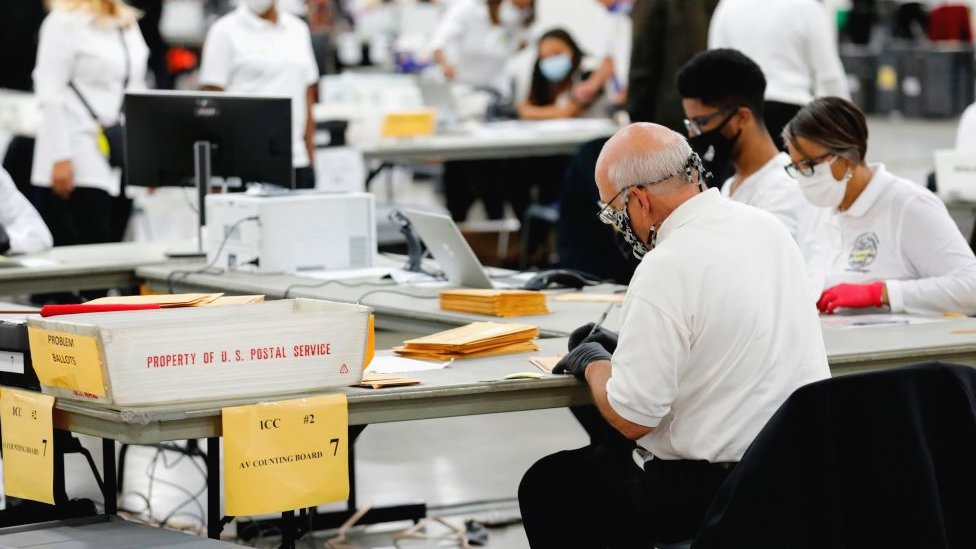 image copyrightGetty Images
Mr Giuliani's remarks were based on a claim made by an election worker, alleging she saw two vans which were meant to bring food, but she says she "never saw any food coming out of the vans, coincidentally it was announced on the news that Michigan had found over 100,000 more ballots — not even two hours after the last van left."
However, this claim - and other allegations - were rejected in a ruling on 13 November, with the judge deciding they weren't credible.
There've been other claims from the Republicans about sudden spikes in votes favouring the Democrats in key battleground states - such as Michigan and Wisconsin - implying fraud could be involved.
These spikes can be easily accounted for in the timing of the release of large batches of results for big cities like Milwaukee and Detroit, which are always skewed heavily Democratic.
In some cases, there have been clerical errors or software glitches, which have been corrected after being discovered.
It's also worth noting that the record numbers of postal ballots in this election have overwhelmingly favoured the Democratic party, particularly in urban areas.
In some states (including Michigan and Wisconsin) counting of these postal votes only started once the polls had closed on 3 November. They take longer to count, so you would have expected to see a bump in the Biden vote each time batches of these results were released.
Claim 3: Votes flipped from Trump to Biden
President Trump's legal team also repeated a claim made by him that there had been an issue with the voting system used in some battleground states which supposedly allowed millions of votes to be flipped from him to his rival, Mr Biden.
There is no evidence for this, and none has been provided by the president's legal team.
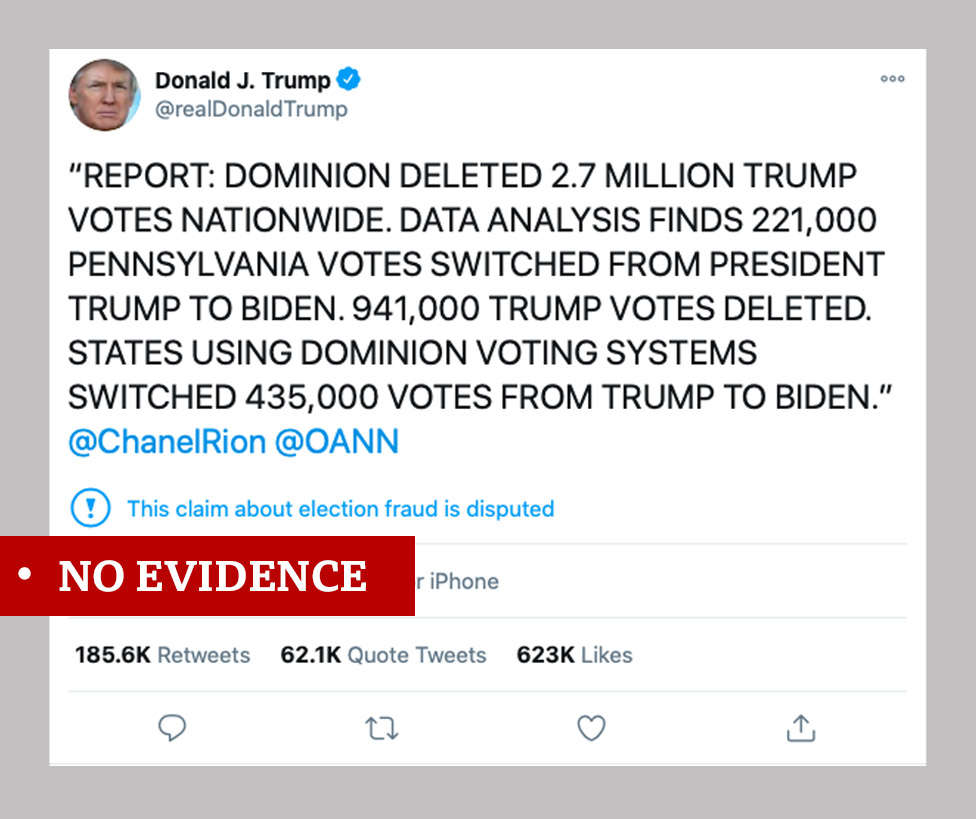
The president is echoing accusations made on the conservative news outlet One America News Network (OANN) about Dominion voting machines, which have been widely used across the US in this election.
An OANN report refers to an "unaudited analysis of data" obtained from an election monitoring group, Edison Research, which allegedly showed millions of votes were flipped.
However, the company's president, Larry Rosin, said: "Edison Research has produced no such report and we have no evidence of any voter fraud."
Edison Research provides many of the major US networks (as well as the BBC) with exit poll data and results.
Dominion Voting Systems has released a statement saying: "Claims about Dominion switching or deleting votes are 100% false."
Claim 4: The voting machines are owned by Democrats
President Trump has said the "Radical Left owned Dominion Voting Systems" with his legal team pointing to ties with Bill and Hillary Clinton and other Democratic politicians.
In a statement, Dominion Voting Systems said it is a non-partisan US company and has no ownership relationships with the Clintons or with top Democratic politician Nancy Pelosi.
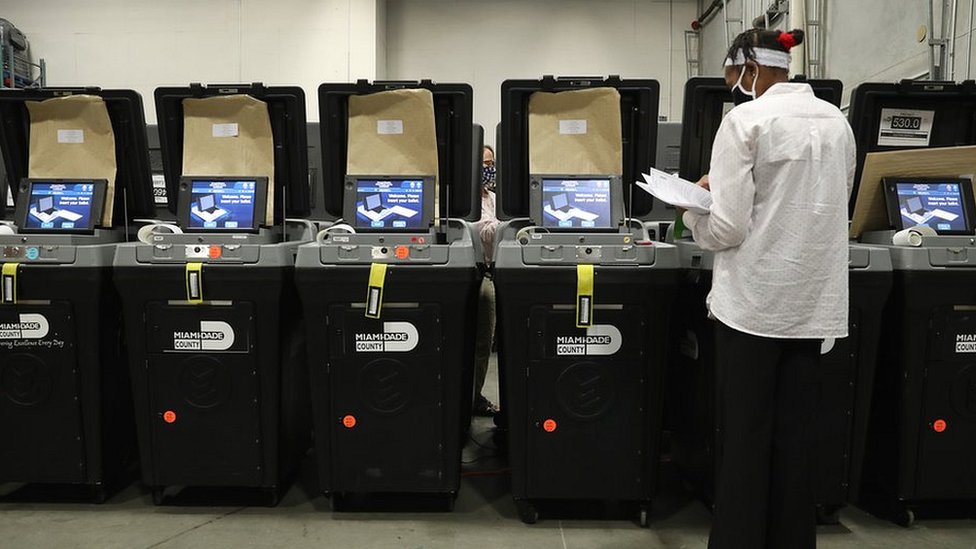 image copyrightGetty Images
It is important to clarify the difference between direct ownership of Dominion as claimed by President Trump, and donations made by the company either for philanthropic or lobbying purposes.
Dominion has made donations to both Republicans and Democrats, but it's not uncommon for a company such as this to lobby for government contracts in this way.
Dominion donated to the Clinton Foundation in 2014, but the company has also donated to Republican Senate Majority Leader Mitch McConnell.
The rumours about Speaker Pelosi stem from her former chief of staff, Nadeam Elshami, being hired by Dominion - but it has also hired staff previously associated with the Republican party.
Claim 5: Thousands of dead people voted
President Trump and his supporters have said ballots were cast for dead people on a massive scale in the election - with thousands voting in key states.
We looked into a list of 10,000 people in the battleground state of Michigan who it was claimed were dead but voted - and found it was fundamentally flawed.
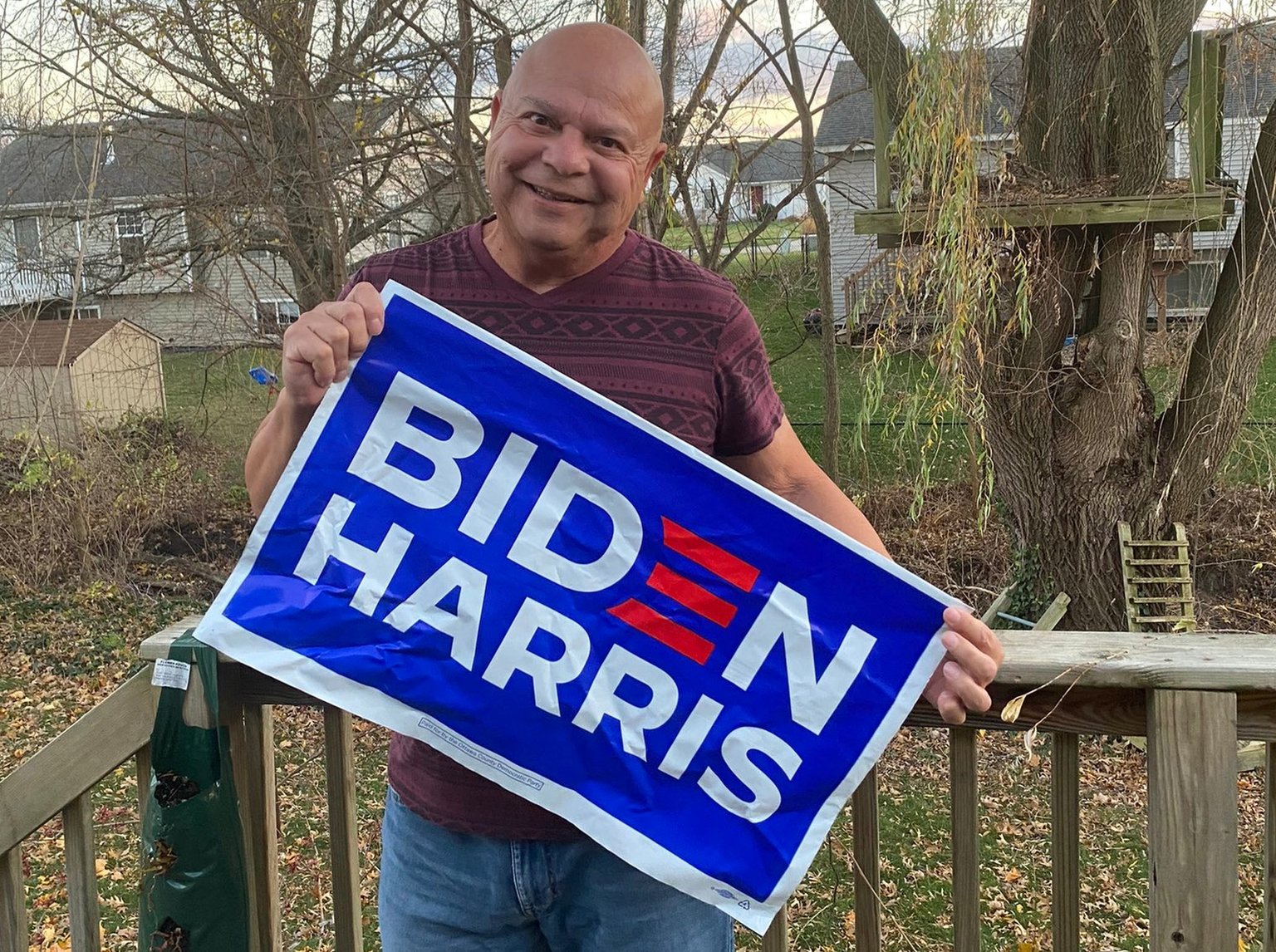 image copyrightRoberto Garcia
Investigations into other "dead voter" lists have come to similar conclusions - with no evidence emerging that there's been widespread fraud through ballots being cast for dead people.
Fox News host Tucker Carlson apologised after he had repeated claims from the Trump campaign and singled out a 'dead voter' in Georgia who subsequently turned out to be alive.
There have been occasions in US elections of dead people having apparently voted, but evidence suggests this is not a widespread problem.
It is often down to clerical errors when legitimate votes are received or perhaps other family members with similar names voting with their ballots.

Comments
Post a Comment