The false prophets of climate doom
Every few years, some self-proclaimed prophet comes along with the
announcement that the world is going to end on some specific date
(usually because of mankind’s sins). These religious doomsayer prophets
receive less publicity than in times past, only to be replaced by
environmental doomsayers. Last week, the good folks at the Competitive
Enterprise Institute have done a service by publishing a new paper,
“Wrong Again: 50 Years of Failed Eco-pocalyptic Predictions.” Below I
have taken a sample of the headlines from among the many articles the
CEI staff found (the full list and complete articles can be found on the
CEI website, www.CEI.org).
“Scientist predicts a new ice age by 21st century” (The Boston Globe, April 16, 1970). “U.S. Scientist Sees New Ice Age Coming” (The Washington Post, July 9, 1971). “Space satellites show new Ice Age coming fast” (The Guardian, January 29, 1974). “The Cooling” (New York Times Book Review, July 18, 1976). “Acid Rain Kills Life in Lakes” (Noblesville Ledger, April 9, 1980). “Acid rain no environmental crisis, study concludes” (Associated Press, September 6, 1990). “Rising seas to obliterate nations by 2000” (Associated Press, June 30, 1989). “New York City’s West Side Highway under water by 2019” (Salon.com, October 23, 2001). “Gore: ‘Entire north polar ice cap will be gone in 5 years’” (WUWT, December 14, 2008).
“Just 96 months to save world from catastrophe, says Prince Charles” (The Independent, July 9, 2009). “Gordon Brown: We have fewer than fifty days to save our planet from catastrophe” (The Independent, October 20, 2009). “French Foreign Minister: ‘500 Days to Avoid Climate Chaos’” (Washington Examiner, May 14, 2014). “Planet Still Standing 500 Days After French Foreign Minister Warned of ‘Climate Chaos’” (Washington Examiner, September 29, 2015).
It is tragically ironic that the CEI paper came out one day before many school children were encouraged to stop studying math and science and take a day off to protest the lack of some unspecified action on global warming. Undoubtedly, the Chinese leadership was duly impressed.
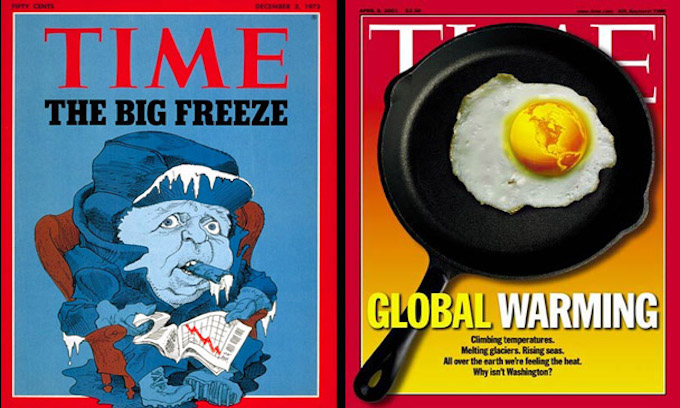
When I was in school, the concern was all about global cooling and the coming ice age, and I recall perhaps America’s best-known scientist at the time, Carl Sagan, showing a TV video clip of New York City under two miles of ice. If you are old enough, you may remember the great acid rain scare where all the fish were going to die in fresh-water lakes because of power plant pollution. In case you were wondering, it didn’t happen.
A few decades ago, the “experts” at the U.N. told us that by 2000 some island nations (e.g. The Maldives) would disappear because of rising sea levels. It turns out that the ocean seems to be rising no faster (to the extent that it can be reliably measured) than it has been doing for many decades. A recent survey of many of the low-lying islands found that very few had gotten smaller while many others had grown larger — surprise, surprise. One explanation is that coral (which lives a few feet underwater and supports many of these islands) rises and falls with sea levels, so there is something close to a steady state rather than disaster.
If you have been to New York City in recent years, you may have noticed that the West Side Highway is still comfortably above the Hudson River water level. I am writing this article in Miami in a building directly across from the Miami City Hall, which is in the old (built in the 1930s) Pan American Seaplane Terminal. It is an interesting art deco building at the water’s edge on Biscayne Bay. After observing this for many years, I note that the Bay seems to be getting no closer to the building proper, and the city commissioners seem perfectly happy with the facility. Yes, the sea is rising, but at such a slow rate that it is relatively easy to adapt to it, and I would be willing to bet that the terminal building (now being a historic property) will be around far longer than most of those reading this column.
We are also told by some scientists and most everyone who is currently running for president that, if we do not act in X number of years (with each having a different number for X), it will be too late — whatever that means. As with the disappearance of the Arctic Sea Ice, these predictions have been made by many over the last few decades, and the specific X years have come, and gone, and no one noticed. Al Gore, who, after decades of telling us that the Sea Ice would be gone and that it was “too late,” had a big article in this past Sunday’s New York Times with the title, “It’s Not Too Late.” Al, I am confused. What am I supposed to believe? The Sea Ice is still with us, and polar bear populations are increasing. And now, you tell us that it is not too late.
• Richard W. Rahn is chairman of the Institute for Global Economic Growth and Improbable Success Productions.
© Copyright (c) 2019 News World Communications, Inc.
======================
While national leaders participate in Climate Week in New York City and elsewhere, one organization reveals the follies of some past ideas about environmental matters.
“Wrong again: 50 years of failed eco-polcalyptic predictions,” wrote Myron Ebell, director, of the Competitive Enterprise Institute’s Center for Energy and Environment, and Steven J. Milloy, a “junk science” expert, and climate scholar.
“Modern doomsayers have been predicting climate and environmental disaster since the 1960s. They continue to do so today. None of the apocalyptic predictions with due dates as of today have come true,” the pair said in their analysis.
“While such predictions have been and continue to be enthusiastically reported by a media eager for sensational headlines, the failures are typically not revisited.”
Here are their favorite examples, and their sources:
“Already too late: Dire famine forecast by 1975” (Los Angeles Times in 1967).
“Everyone will disappear in a cloud of blue steam by 1989” (New York Times, in 1969).
“Scientists predicts a new ice age by 21st century” (The Boston Globe in 1970.
“America subject to water rationing by 1974 and food rationing by 1980” (Redlands Daily Facts in 1970).
“U.S. scientists see new ice age coming” (Washington Post, in 1971).
“Great peril to Life: Gas pares away Earth’s ozone” (United Press International in 1974).
=========================
Idiotic Predictions:
The Competitive Enterprise Institute has published a new paper, “Wrong Again: 50 Years of Failed Eco-pocalyptic Predictions.” Keep in mind that many of the grossly wrong environmentalist predictions were made by respected scientists and government officials. My question for you is: If you were around at the time, how many government restrictions and taxes would you have urged to avoid the predicted calamity?
As reported in The New York Times (Aug. 1969) Stanford University biologist Dr. Paul Erhlich warned: “The trouble with almost all environmental problems is that by the time we have enough evidence to convince people, you’re dead. We must realize that unless we’re extremely lucky, everybody will disappear in a cloud of blue steam in 20 years.”
In 2000, Dr. David Viner, a senior research scientist at University of East Anglia’s climate research unit, predicted that in a few years winter snowfall would become “a very rare and exciting event. Children just aren’t going to know what snow is.” In 2004, the U.S. Pentagon warned President George W. Bush that major European cities would be beneath rising seas. Britain will be plunged into a Siberian climate by 2020. In 2008, Al Gore predicted that the polar ice cap would be gone in a mere 10 years. A U.S. Department of Energy study led by the U.S. Navy predicted the Arctic Ocean would experience an ice-free summer by 2016.
In May 2014, French Foreign Minister Laurent Fabius declared during a joint appearance with Secretary of State John Kerry that “we have 500 days to avoid climate chaos.”
Peter Gunter, professor at North Texas State University, predicted in the spring 1970 issue of The Living Wilderness: “Demographers agree almost unanimously on the following grim timetable: by 1975 widespread famines will begin in India; these will spread by 1990 to include all of India, Pakistan, China and the Near East, Africa. By the year 2000, or conceivably sooner, South and Central America will exist under famine conditions. … By the year 2000, thirty years from now, the entire world, with the exception of Western Europe, North America, and Australia, will be in famine.”
Ecologist Kenneth Watt’s 1970 prediction was, “If present trends continue, the world will be about four degrees colder for the global mean temperature in 1990, but eleven degrees colder in the year 2000.” He added, “This is about twice what it would take to put us into an ice age.”
Mark J. Perry, scholar at the American Enterprise Institute and professor of economics and finance at the University of Michigan’s Flint campus, cites 18 spectacularly wrong predictions made around the time of first Earth Day in 1970. This time it’s not about weather. Harrison Brown, a scientist at the National Academy of Sciences, published a chart in Scientific American that looked at metal reserves and estimated that humanity would run out of copper shortly after 2000. Lead, zinc, tin, gold and silver would be gone before 1990. Kenneth Watt said, “By the year 2000, if present trends continue, we will be using up crude oil at such a rate … that there won’t be any more crude oil.”
There were grossly wild predictions well before the first Earth Day, too. In 1939, the U.S. Department of the Interior predicted that American oil supplies would last for only another 13 years. In 1949, the secretary of the interior said the end of U.S. oil supplies was in sight. Having learned nothing from its earlier erroneous energy claims, in 1974, the U.S. Geological Survey said that the U.S. had only a 10-year supply of natural gas. However, the U.S. Energy Information Administration estimated that as of Jan. 1, 2017, there were about 2,459 trillion cubic feet of dry natural gas in the United States. That’s enough to last us for nearly a century. The United States is the largest producer of natural gas worldwide.
Today’s wild predictions about climate doom are likely to be just as true as yesteryear’s. The major difference is today’s Americans are far more gullible and more likely to spend trillions fighting global warming. And the only result is that we’ll be much poorer and less free.
“Scientist predicts a new ice age by 21st century” (The Boston Globe, April 16, 1970). “U.S. Scientist Sees New Ice Age Coming” (The Washington Post, July 9, 1971). “Space satellites show new Ice Age coming fast” (The Guardian, January 29, 1974). “The Cooling” (New York Times Book Review, July 18, 1976). “Acid Rain Kills Life in Lakes” (Noblesville Ledger, April 9, 1980). “Acid rain no environmental crisis, study concludes” (Associated Press, September 6, 1990). “Rising seas to obliterate nations by 2000” (Associated Press, June 30, 1989). “New York City’s West Side Highway under water by 2019” (Salon.com, October 23, 2001). “Gore: ‘Entire north polar ice cap will be gone in 5 years’” (WUWT, December 14, 2008).
“Just 96 months to save world from catastrophe, says Prince Charles” (The Independent, July 9, 2009). “Gordon Brown: We have fewer than fifty days to save our planet from catastrophe” (The Independent, October 20, 2009). “French Foreign Minister: ‘500 Days to Avoid Climate Chaos’” (Washington Examiner, May 14, 2014). “Planet Still Standing 500 Days After French Foreign Minister Warned of ‘Climate Chaos’” (Washington Examiner, September 29, 2015).
It is tragically ironic that the CEI paper came out one day before many school children were encouraged to stop studying math and science and take a day off to protest the lack of some unspecified action on global warming. Undoubtedly, the Chinese leadership was duly impressed.
When I was in school, the concern was all about global cooling and the coming ice age, and I recall perhaps America’s best-known scientist at the time, Carl Sagan, showing a TV video clip of New York City under two miles of ice. If you are old enough, you may remember the great acid rain scare where all the fish were going to die in fresh-water lakes because of power plant pollution. In case you were wondering, it didn’t happen.
A few decades ago, the “experts” at the U.N. told us that by 2000 some island nations (e.g. The Maldives) would disappear because of rising sea levels. It turns out that the ocean seems to be rising no faster (to the extent that it can be reliably measured) than it has been doing for many decades. A recent survey of many of the low-lying islands found that very few had gotten smaller while many others had grown larger — surprise, surprise. One explanation is that coral (which lives a few feet underwater and supports many of these islands) rises and falls with sea levels, so there is something close to a steady state rather than disaster.
If you have been to New York City in recent years, you may have noticed that the West Side Highway is still comfortably above the Hudson River water level. I am writing this article in Miami in a building directly across from the Miami City Hall, which is in the old (built in the 1930s) Pan American Seaplane Terminal. It is an interesting art deco building at the water’s edge on Biscayne Bay. After observing this for many years, I note that the Bay seems to be getting no closer to the building proper, and the city commissioners seem perfectly happy with the facility. Yes, the sea is rising, but at such a slow rate that it is relatively easy to adapt to it, and I would be willing to bet that the terminal building (now being a historic property) will be around far longer than most of those reading this column.
We are also told by some scientists and most everyone who is currently running for president that, if we do not act in X number of years (with each having a different number for X), it will be too late — whatever that means. As with the disappearance of the Arctic Sea Ice, these predictions have been made by many over the last few decades, and the specific X years have come, and gone, and no one noticed. Al Gore, who, after decades of telling us that the Sea Ice would be gone and that it was “too late,” had a big article in this past Sunday’s New York Times with the title, “It’s Not Too Late.” Al, I am confused. What am I supposed to believe? The Sea Ice is still with us, and polar bear populations are increasing. And now, you tell us that it is not too late.
• Richard W. Rahn is chairman of the Institute for Global Economic Growth and Improbable Success Productions.
© Copyright (c) 2019 News World Communications, Inc.
======================
While national leaders participate in Climate Week in New York City and elsewhere, one organization reveals the follies of some past ideas about environmental matters.
“Wrong again: 50 years of failed eco-polcalyptic predictions,” wrote Myron Ebell, director, of the Competitive Enterprise Institute’s Center for Energy and Environment, and Steven J. Milloy, a “junk science” expert, and climate scholar.
“Modern doomsayers have been predicting climate and environmental disaster since the 1960s. They continue to do so today. None of the apocalyptic predictions with due dates as of today have come true,” the pair said in their analysis.
“While such predictions have been and continue to be enthusiastically reported by a media eager for sensational headlines, the failures are typically not revisited.”
Here are their favorite examples, and their sources:
“Already too late: Dire famine forecast by 1975” (Los Angeles Times in 1967).
“Everyone will disappear in a cloud of blue steam by 1989” (New York Times, in 1969).
“Scientists predicts a new ice age by 21st century” (The Boston Globe in 1970.
“America subject to water rationing by 1974 and food rationing by 1980” (Redlands Daily Facts in 1970).
“U.S. scientists see new ice age coming” (Washington Post, in 1971).
“Great peril to Life: Gas pares away Earth’s ozone” (United Press International in 1974).
=========================
Idiotic Predictions:
The Competitive Enterprise Institute has published a new paper, “Wrong Again: 50 Years of Failed Eco-pocalyptic Predictions.” Keep in mind that many of the grossly wrong environmentalist predictions were made by respected scientists and government officials. My question for you is: If you were around at the time, how many government restrictions and taxes would you have urged to avoid the predicted calamity?
As reported in The New York Times (Aug. 1969) Stanford University biologist Dr. Paul Erhlich warned: “The trouble with almost all environmental problems is that by the time we have enough evidence to convince people, you’re dead. We must realize that unless we’re extremely lucky, everybody will disappear in a cloud of blue steam in 20 years.”
In 2000, Dr. David Viner, a senior research scientist at University of East Anglia’s climate research unit, predicted that in a few years winter snowfall would become “a very rare and exciting event. Children just aren’t going to know what snow is.” In 2004, the U.S. Pentagon warned President George W. Bush that major European cities would be beneath rising seas. Britain will be plunged into a Siberian climate by 2020. In 2008, Al Gore predicted that the polar ice cap would be gone in a mere 10 years. A U.S. Department of Energy study led by the U.S. Navy predicted the Arctic Ocean would experience an ice-free summer by 2016.
In May 2014, French Foreign Minister Laurent Fabius declared during a joint appearance with Secretary of State John Kerry that “we have 500 days to avoid climate chaos.”
Peter Gunter, professor at North Texas State University, predicted in the spring 1970 issue of The Living Wilderness: “Demographers agree almost unanimously on the following grim timetable: by 1975 widespread famines will begin in India; these will spread by 1990 to include all of India, Pakistan, China and the Near East, Africa. By the year 2000, or conceivably sooner, South and Central America will exist under famine conditions. … By the year 2000, thirty years from now, the entire world, with the exception of Western Europe, North America, and Australia, will be in famine.”
Ecologist Kenneth Watt’s 1970 prediction was, “If present trends continue, the world will be about four degrees colder for the global mean temperature in 1990, but eleven degrees colder in the year 2000.” He added, “This is about twice what it would take to put us into an ice age.”
Mark J. Perry, scholar at the American Enterprise Institute and professor of economics and finance at the University of Michigan’s Flint campus, cites 18 spectacularly wrong predictions made around the time of first Earth Day in 1970. This time it’s not about weather. Harrison Brown, a scientist at the National Academy of Sciences, published a chart in Scientific American that looked at metal reserves and estimated that humanity would run out of copper shortly after 2000. Lead, zinc, tin, gold and silver would be gone before 1990. Kenneth Watt said, “By the year 2000, if present trends continue, we will be using up crude oil at such a rate … that there won’t be any more crude oil.”
There were grossly wild predictions well before the first Earth Day, too. In 1939, the U.S. Department of the Interior predicted that American oil supplies would last for only another 13 years. In 1949, the secretary of the interior said the end of U.S. oil supplies was in sight. Having learned nothing from its earlier erroneous energy claims, in 1974, the U.S. Geological Survey said that the U.S. had only a 10-year supply of natural gas. However, the U.S. Energy Information Administration estimated that as of Jan. 1, 2017, there were about 2,459 trillion cubic feet of dry natural gas in the United States. That’s enough to last us for nearly a century. The United States is the largest producer of natural gas worldwide.
Today’s wild predictions about climate doom are likely to be just as true as yesteryear’s. The major difference is today’s Americans are far more gullible and more likely to spend trillions fighting global warming. And the only result is that we’ll be much poorer and less free.

Comments
Post a Comment